Shopify vs WooCommerce vs Custom: Which Ecommerce Platform Should a US Store
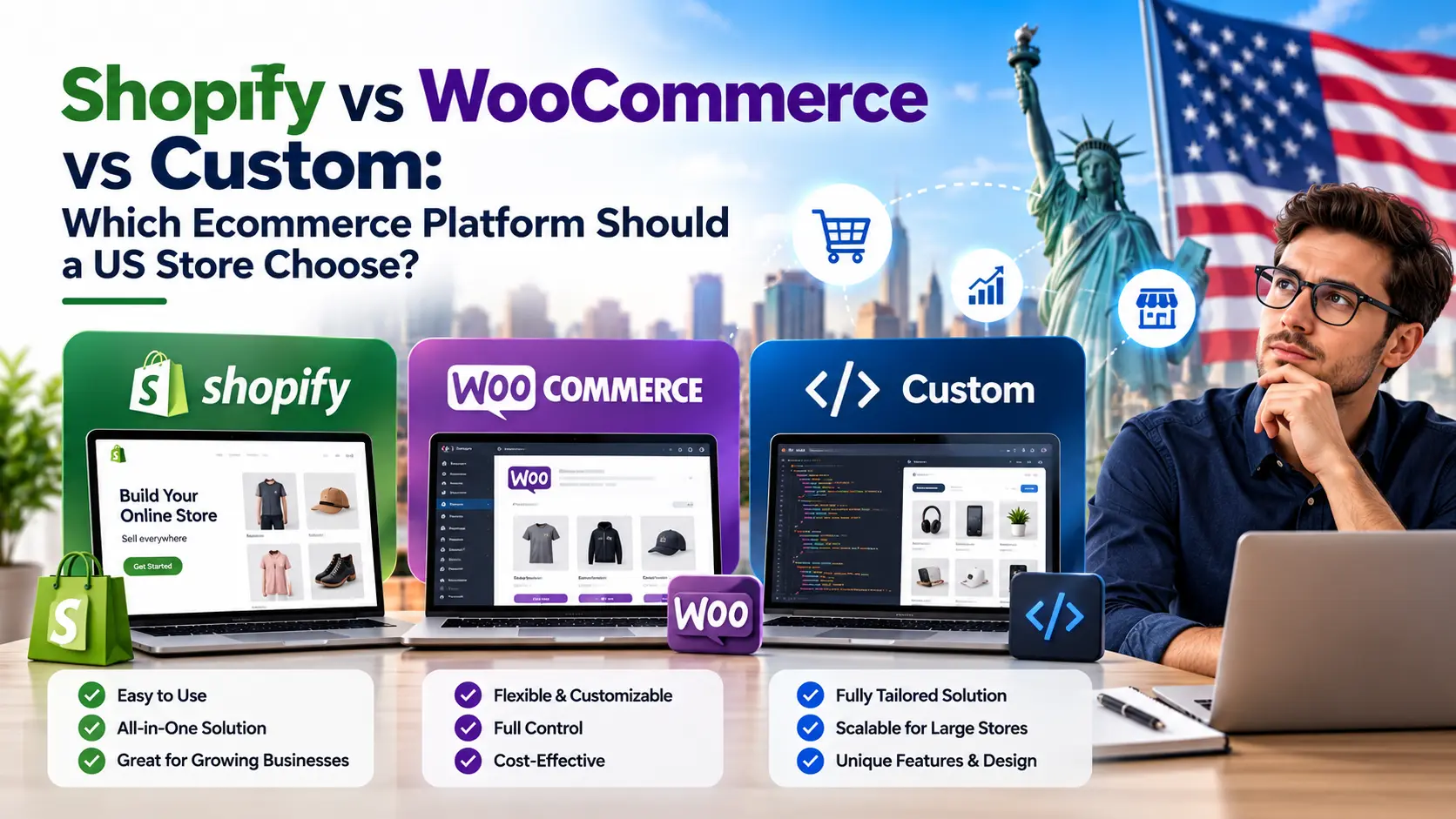
Quick answer: Pick Shopify if you want a hosted, low-maintenance store and your catalogue is fairly standard. Pick WooCommerce if you want full control on WordPress and have someone to maintain it. Pick a custom build when your products, pricing or workflow do not fit a template, such as made-to-order items with design tools. Price changes often, so check current plans before deciding.
What the market share numbers really say
Headlines love to declare a winner, but the data depends on what you count. HTTP Archive figures for May 2026, summarised by GravityKit, show WooCommerce on 6.64% of the measurable web against Shopify's 4.76%. Look only at the top one million sites and the picture flips: Shopify at 6.08% and WooCommerce at 3.12%. The same source reports detected Shopify sites growing 11.7% year on year while WooCommerce detections fell 6.8%.
The honest reading is that WooCommerce is everywhere, because it is free to install on millions of WordPress sites, while Shopify is where more of the larger, busier stores choose to be. Neither is "better". They suit different situations.
Shopify: fast to launch, less to maintain
Shopify handles hosting, security patches, checkout and a large app marketplace. That is a real advantage if you do not want to worry about servers. Trade-offs include monthly plan and app fees that add up, transaction fees if you do not use its own payments, and less freedom to change how the platform behaves under the hood. It is a strong fit for standard retail with a clean product catalogue.
WooCommerce: control and flexibility, with homework
WooCommerce lives inside WordPress, so you own the code and data, and the plugin range is huge. You also own the upkeep: updates, backups, hosting quality and security. Plugins are the usual weak point, and one data source puts the share of WordPress vulnerabilities found in plugins, not core, at 91%. That is manageable with a maintenance routine, and a risk if nobody is responsible. It suits businesses that already use WordPress for content and have a developer or agency on call.
Custom development: when the product is the difficulty
If you sell items customers design, such as custom patches, apparel, signage or packaging, you may need a product designer, live price calculation, artwork upload and approval, quantity tiers and a production workflow. Templates and plugins can fake some of this, and there often comes a point where the workarounds cost more than building the right thing. Custom also makes sense for complex B2B pricing, integrations with ERP or inventory systems, and unusual fulfilment.
The trade-off is a higher upfront cost and the need to plan maintenance. A good custom build earns its keep when it removes manual work every day.
A quick way to decide
- Standard products, small team, want to launch quickly: Shopify
- Content-heavy site on WordPress, comfortable with maintenance: WooCommerce
- Made-to-order products, design tools, complex pricing or integrations: Custom build
- Not sure, limited budget: Start on Shopify or WooCommerce and plan the move later
Questions to ask before you choose
- How many products, and how often do they change?
- Do customers customise anything?
- Who will update and secure the store every month?
- What do you need to connect, such as accounting, shipping, ERP or CRM?
- What does the total cost look like over three years, including apps, plugins, hosting and developer time?
- How easy is it to export your data if you leave?
SEO and speed apply to all three
Whatever platform you choose, the same basics decide your search performance: fast pages on mobile, clean URLs, unique product descriptions, structured data for products and reviews, and clear delivery and returns information. Google's page experience targets are LCP under 2.5 seconds, INP under 200 milliseconds and CLS under 0.1. A badly built store on a famous platform will lose to a well-built store on a quieter one.
FAQs
Is Shopify better than WooCommerce?
Not universally. Shopify is easier to run, WooCommerce is more flexible, and the right choice depends on your products, team and budget.
When should I move to a custom store?
When workarounds, plugins and manual processes are costing you more than a purpose-built system would.
Can I migrate later?
Yes, but it takes planning. Keep clean product data and redirect old URLs to preserve search rankings.
Which platform is best for SEO?
All three can rank well. Execution matters more than the logo.
Related reading: Is Your Website Accessible? What US Businesses Need to Know About ADA Website Lawsuits in 2026
Choosing a platform?
Websigntist builds Shopify, WooCommerce and custom e-commerce stores for US businesses and others. If you want a straight recommendation for your products, talk to us.
Source: GravityKit, Ecommerce platform market share 2026 (HTTP Archive, May 2026); Colorlib, WordPress hacking statistics.
Get a fixed, itemised quote for your project

Written by
Muhammad Adnan
Founder & Director, Websigntist
Muhammad Adnan is the founder and director of Websigntist, a digital solution and global IT consulting company. He has 14+ years of experience working with 120+ clients from 10+ countries helping businesses with website design and development, eCommerce, SEO, digital marketing, branding and custom digital solutions. He's all about building practical, reliable and results-driven solutions that help businesses achieve online growth, as reflected by a 98% client satisfaction rate.