Is Your Website Invisible to AI Search? What Google's AI Overviews Mean for Your Business
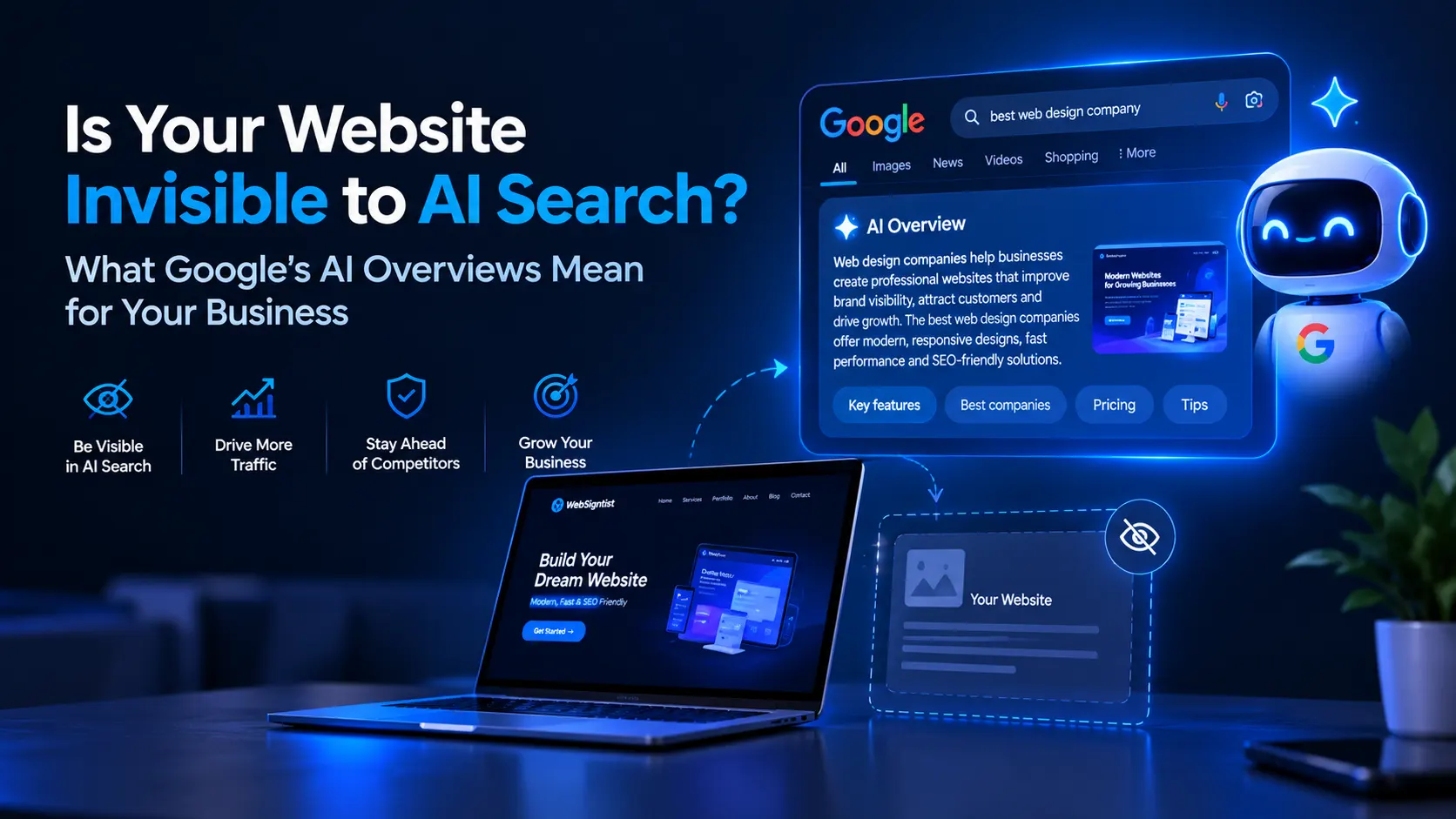
Type a question into Google today and there's a real chance you'll never scroll past the answer sitting right at the top of the page, generated instantly, no click required. That's not a hypothetical anymore. As of late 2025, roughly 30% of desktop searches trigger an AI Overview, and for question-based searches, the kind most businesses actually want to rank for, that number jumps to nearly 58%. Two billion people a month are now reading answers Google writes for them instead of clicking through to the sites that used to earn that traffic.
Here's the number that should get your attention if you run a business online: organic click-through rate drops by 61% on average when an AI Overview shows up for a search, and individual sites are seeing their own click-through fall by roughly a third on the exact keywords they used to rank well for. Add to that 43% of AI Overview searches ending with no click at all, and over a quarter of users leaving Google entirely once they've read the summary, and the picture gets clear fast. Ranking well isn't the win it used to be. Getting cited inside that AI-generated answer is.
Why Being Cited Matters More Than Being Ranked
This is the part most businesses haven't caught up to yet. A page that gets quoted or referenced inside an AI Overview sees its click-through rate jump 35% compared to a page ranking in the same spot without that citation. And the traffic that does come through from AI-driven referrals converts at 14.2%, compared to just 2.8% for regular organic traffic, a 23x difference. Fewer people are clicking overall, but the ones who do are far more likely to actually buy, book, or inquire.
So the real question for 2026 isn't "how do I rank higher." It's "how do I become the source an AI system pulls from when it's building its answer." Those are related skills, but they're not identical, and treating them as the same thing is exactly why some businesses are watching their traffic quietly erode without understanding why.
What Actually Gets a Page Cited
AI systems, whether it's Google's own AI Overviews or ChatGPT pulling from the web, tend to favor content that answers a question directly and early, rather than making a reader scroll through three paragraphs of preamble to get there. Clear structure matters. Pages with well-organized headers, direct answers near the top, and genuinely specific facts, numbers, names, dates, get pulled into these summaries far more often than pages that are vague but well-written.
Structured data helps too. Schema markup that clearly labels what your page is, who wrote it, and what it's actually about gives these systems an easier path to understanding and trusting your content. And credibility signals still count. Content tied to a real author, a real business with a real track record, tends to get cited over anonymous or thin pages, even when the writing quality is similar.
What This Means If You Run a Business
If your website traffic has felt like it's quietly declining even though your rankings look fine, this is very possibly why. The fix isn't to panic and rewrite everything overnight. It's to start treating your most important pages, the ones answering real questions your customers ask, as content built to be extracted and cited, not just skimmed by a human scrolling past an ad. That means direct answers, real specifics, clean structure, and enough authority behind the page that an AI system has a reason to trust it.
The businesses that adjust to this now are going to keep showing up in front of customers over the next few years. The ones that keep optimizing purely for the old rules are going to wonder, twelve months from now, where their traffic went.
How to Tell If This Is Already Happening to You
Pull up your search console data and compare impressions to clicks over the last six months, specifically for your highest-volume keywords. If impressions have held steady or even climbed while clicks have quietly slid, that's usually the fingerprint of AI Overviews eating into your click-through rate rather than an actual ranking drop. A lot of businesses misread this pattern as "SEO stopped working" and start second-guessing strategies that were never actually broken, when the real shift happened one layer up, in how Google presents the answer before anyone reaches your page at all.
It's also worth checking which of your competitors are showing up inside AI Overviews for shared keywords, since that tells you a lot about what Google currently considers a trustworthy source in your specific space. If it's consistently the same two or three sites, that's a strong signal about the kind of content and credibility markers currently winning that citation slot, and a reasonable starting point for what your own pages need to catch up on.
Get a fixed, itemised quote for your project

Written by
Muhammad Adnan
Founder & Director, Websigntist
Muhammad Adnan is the founder and director of Websigntist, a digital solution and global IT consulting company. He has 14+ years of experience working with 120+ clients from 10+ countries helping businesses with website design and development, eCommerce, SEO, digital marketing, branding and custom digital solutions. He's all about building practical, reliable and results-driven solutions that help businesses achieve online growth, as reflected by a 98% client satisfaction rate.