Why Google Can Tell When Your Website's Content Was Written by AI
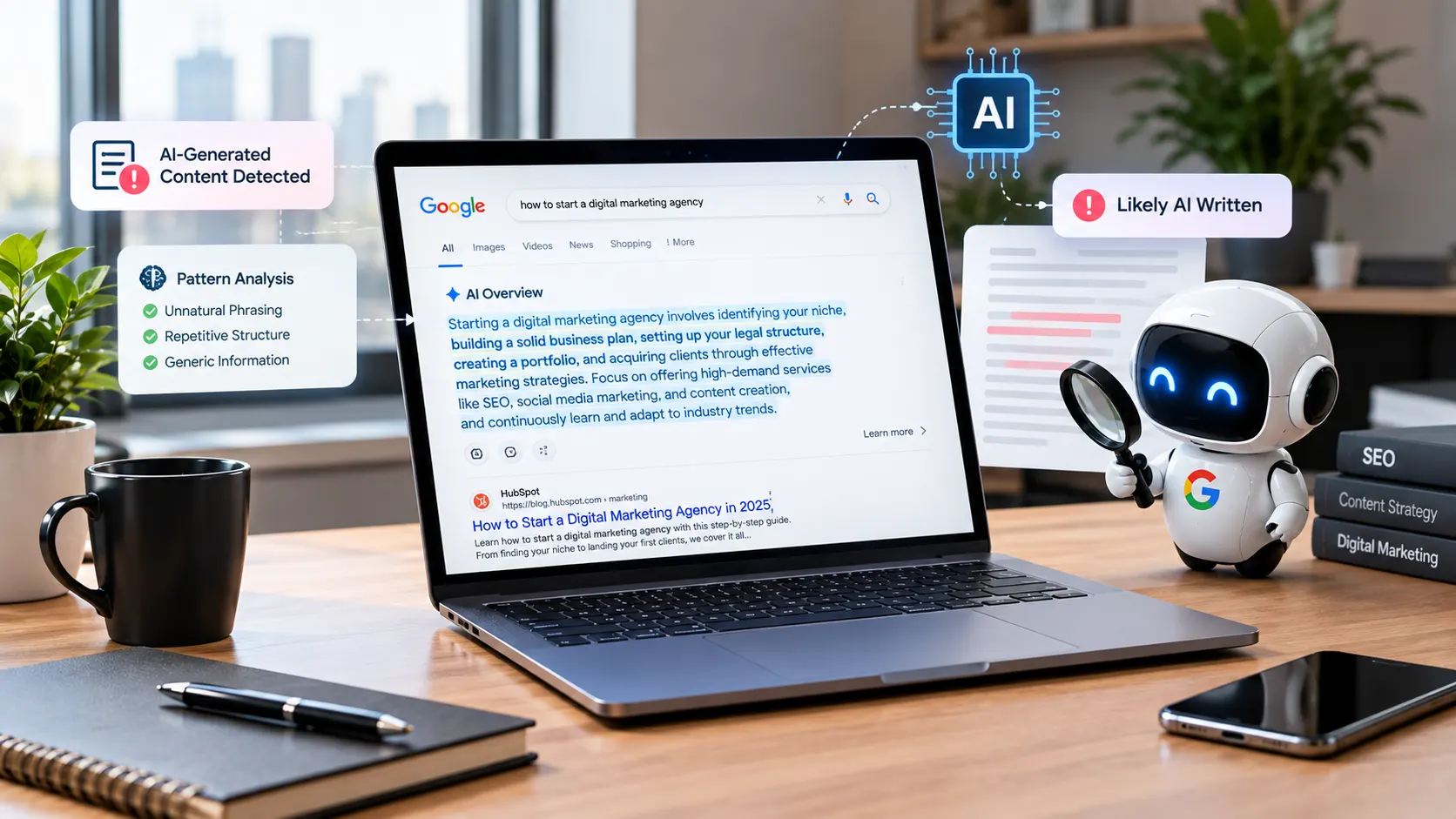
Roughly 74% of newly published web pages now contain some amount of AI-generated content, according to a large-scale study of nearly a million pages. That number alone tends to alarm business owners who've heard rumors that Google is quietly punishing anything AI touches. The actual data tells a more useful, more specific story.
What Google Actually Does
Across an analysis of 600,000 pages, researchers found essentially no correlation, a coefficient of just 0.011, between a page being AI-assisted and getting penalized in search rankings. Google has been consistent about this publicly too: it doesn't care how content was produced, it cares whether the content is genuinely useful. What it has cracked down on hard since mid-2025 is something different, "scaled content abuse," meaning low-quality AI pages published in bulk with no real editing or expertise behind them, purely to game search rankings. That's the behavior getting penalized, not AI assistance itself.
What Actually Shows Up in Top Rankings
Here's the detail that surprises most people: 86% of currently top-ranking Google pages are still primarily human-authored. At the same time, 86.5% of content across the top 20 results for competitive searches contains at least some AI involvement, whether that's AI-assisted drafting, editing, or research support. Put those two numbers together and the pattern is clear: pure, unedited AI output rarely wins, but AI used as part of a real editorial process, one with a human actually shaping, fact-checking, and improving the result, performs just fine.
That shows up in reader behavior too. Content that started as AI-generated but went through real human editing saw bounce rates drop by 73% and conversions rise by 36% compared to unedited AI output. But readers aren't naive either: while 73% of people say they generally trust AI-assisted content, 52% will disengage the moment they recognize a piece as obviously AI-written with no real human touch behind it.
What This Actually Means for a Business Publishing Content
The risk was never "don't use AI." The risk is publishing thin, generic, obviously unedited AI content at scale and hoping volume makes up for quality, which is exactly the behavior Google has spent the last year specifically targeting. A business using AI as a starting point, then having someone who actually understands the topic edit, verify, and add real specifics and judgment, is doing exactly what the data shows performs best. The businesses getting quietly penalized right now aren't the ones using AI. They're the ones using it as a replacement for having anyone think about what they're publishing at all.
How to Actually Get This Right
Use AI for what it's genuinely fast at, structuring a draft, generating an outline, clearing writer's block, then have a real person with actual knowledge of the subject go through and add the specifics a generic model can't know: your own numbers, your own client examples, an opinion shaped by having actually done the work. Cut anything that reads like it could apply to literally any business in your industry, since that's usually the exact material a search engine, and a reader, will recognize as filler. The goal was never to make content that's undetectable as AI-assisted. It was always to make content good enough that nobody cares how it got written.
Get a fixed, itemised quote for your project

Written by
Muhammad Adnan
Founder & Director, Websigntist
Muhammad Adnan is the founder and director of Websigntist, a digital solution and global IT consulting company. He has 14+ years of experience working with 120+ clients from 10+ countries helping businesses with website design and development, eCommerce, SEO, digital marketing, branding and custom digital solutions. He's all about building practical, reliable and results-driven solutions that help businesses achieve online growth, as reflected by a 98% client satisfaction rate.